Denmark Travel Warning: What Every Traveler Should Know Before Visiting (2026 Update)

Denmark is consistently ranked among the safest, happiest, and most livable countries in the world — but that doesn’t mean travelers should skip their homework. If you’re planning a trip to Copenhagen, the Danish countryside, or the wider Kingdom of Denmark, understanding the current Denmark travel warning issued by official government bodies is an essential first step in your planning process.
This guide breaks down exactly what the advisory covers, why it exists, and what practical steps you can take to travel with confidence.
What Does the Current Denmark Travel Warning Say?
The U.S. Department of State currently places Denmark at Level 2: Exercise Increased Caution on its four-tier Travel Advisory scale. This is the same level assigned to many popular European destinations, and it sits well below Level 3 (“Reconsider Travel”) or Level 4 (“Do Not Travel”).
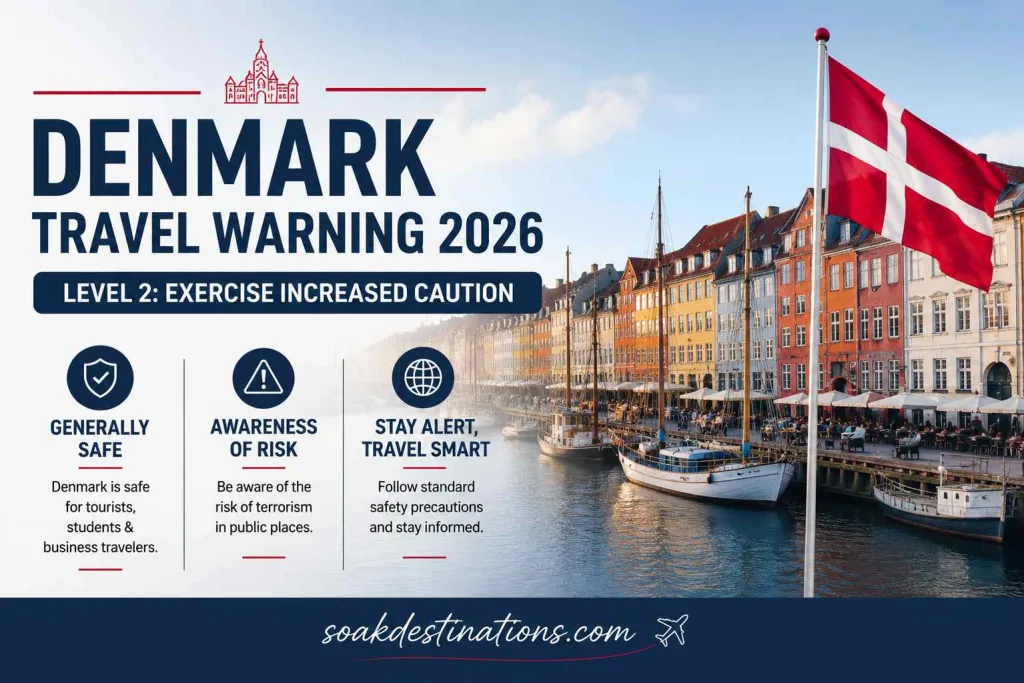
In plain terms, a Denmark travel warning at this level means:
- Denmark is generally safe for tourists, students, and business travelers
- There is a specific, named risk factor — in this case, terrorism — that travelers should be aware of
- Standard safety precautions are recommended, but no restriction on travel itself is advised
According to the official U.S. Department of State Travel Advisory for Denmark, the advisory is reissued periodically after routine review, and the underlying guidance has remained consistent: exercise increased caution in the Kingdom of Denmark due to terrorism.
Understanding the Level 2 Classification
Level 2 sits in the middle of a five-point transparency system used by the State Department to communicate risk. It signals awareness, not avoidance — travelers are encouraged to stay alert in public spaces rather than cancel their plans.
Why Has a Denmark Travel Warning Been Issued?
The core reason behind the current Denmark travel warning is terrorism, not crime, political unrest, or natural disaster risk. Official country summaries note that terrorist groups continue plotting possible attacks within the Kingdom of Denmark, and that such attacks could occur with little or no warning.
Potential targets identified in official guidance include:
- Tourist spots and transport hubs
- Markets and shopping malls
- Local government facilities
- Hotels, clubs, and restaurants
- Places of religious importance
- Parks and public gathering spaces
- Major sporting and cultural events
- Schools and airports
Danish authorities maintain a domestic terror threat level of “significant” — 4 out of 5 on their national scale — reflecting an assessment that an attack is possible, though not necessarily imminent. Reports from the Danish Security and Intelligence Service point to online radicalization, particularly among younger individuals, as a growing and increasingly fragmented threat with no centralized organizational structure.
What This Means for Everyday Travelers
Realistically, the risk to any individual tourist remains low, and Denmark’s overall violent crime rate is far below the global average. The advisory exists so travelers can make informed decisions, not to discourage the trip itself.
The Kingdom of Denmark: Greenland and the Faroe Islands
Many travelers are surprised to learn that official advisories cover more than mainland Denmark. The Kingdom of Denmark legally comprises three distinct territories: Denmark itself, the Faroe Islands, and Greenland — each with its own entry rules and considerations.
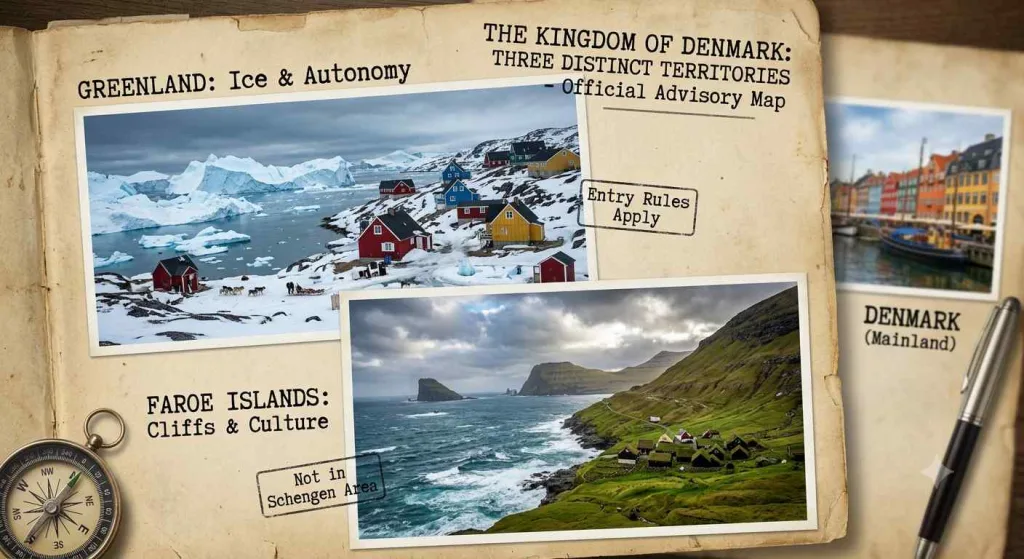
- Greenland has drawn additional international attention recently amid geopolitical discussions involving its strategic and resource significance, prompting some travelers to specifically research conditions before visiting
- The Faroe Islands are not part of the Schengen Agreement, though U.S. citizens may still visit for up to 90 days for business or tourism without a visa
- Residence and work permits issued for the Faroe Islands are not valid elsewhere in the Schengen area
Travelers heading to any of these territories should review the specific country information page for that region rather than relying solely on the general Denmark advisory.
Crime and Everyday Safety Concerns
Beyond the terrorism-related Denmark travel warning, most safety issues travelers actually encounter in Denmark are far more mundane — petty theft rather than violent crime.
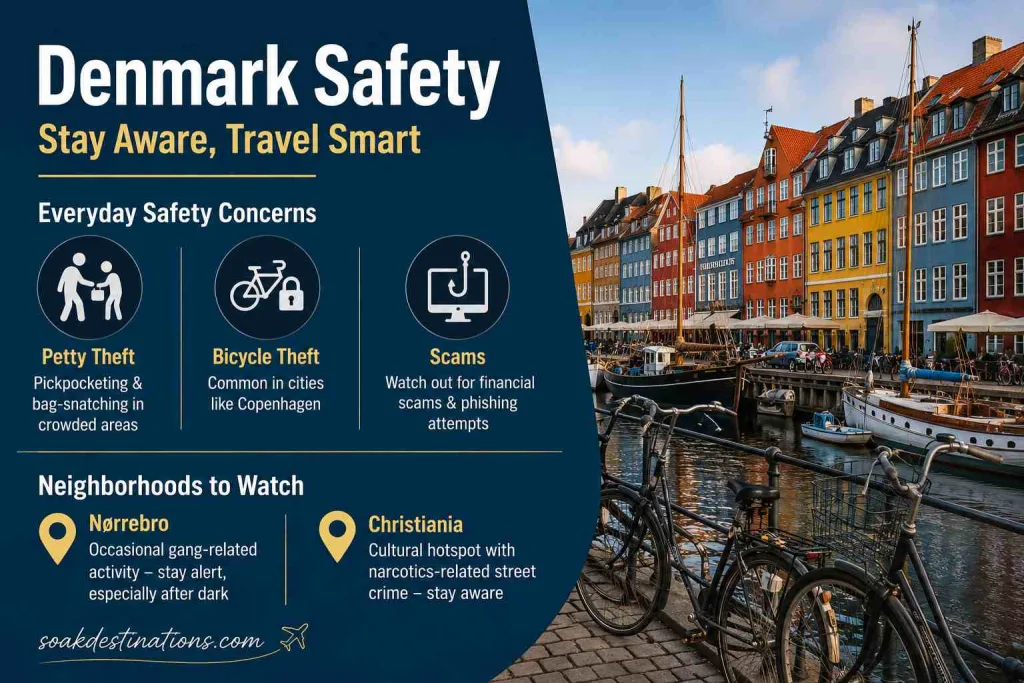
- Pickpocketing and bag-snatching are the most commonly reported issues, particularly in crowded tourist areas, train stations, and hotel lobbies
- Bicycle theft is common in cities like Copenhagen, where cycling is the dominant mode of transport
- Financial scams, including fraudulent online listings and phishing attempts, are flagged by both the State Department and the FBI as growing concerns for international travelers
Neighborhoods That Warrant Extra Awareness
Certain areas of Copenhagen, including parts of Nørrebro and the semi-autonomous Christiania district, occasionally experience gang-related activity and narcotics-related street crime. Visitors are not barred from these neighborhoods — both are popular, culturally significant areas — but it’s worth staying alert, particularly after dark.
Health, Entry, and Border Requirements
Denmark’s healthcare system is excellent, and the country poses relatively few health risks compared to many international destinations. Still, official sources recommend a few precautions:
- Ensure routine vaccinations, including MMR, are up to date before travel
- Denmark is part of the Schengen Agreement; your passport should generally be valid for at least six months beyond your entry date
- U.S. citizens may enter for up to 90 days for tourism without a visa
- Amounts exceeding 10,000 Euros (or the equivalent) must be declared at the border
- The EU’s Entry/Exit System (EES) introduces biometric registration for non-EU travelers, so allow extra time at border checkpoints
For the latest health-specific guidance, the CDC’s Denmark travel health page is a useful supplementary resource alongside the official government advisory.
Practical Steps to Travel Safely Despite the Advisory
A Denmark travel warning doesn’t mean staying home — it means traveling smart. Officials recommend the following precautions:
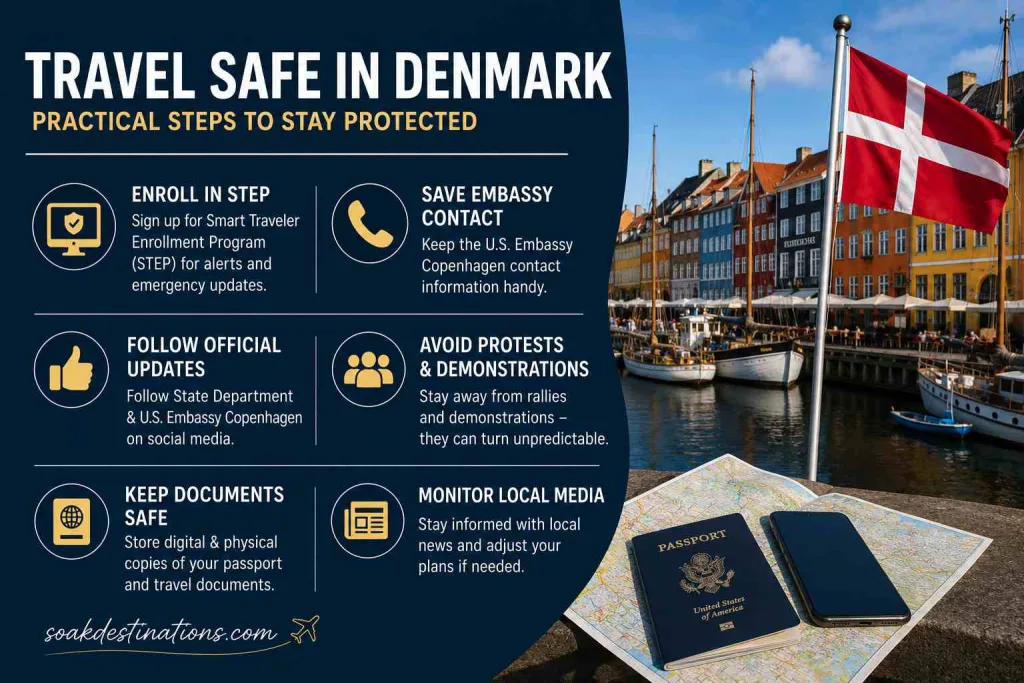
- Enroll in the Smart Traveler Enrollment Program (STEP) to receive real-time alerts and make it easier for the embassy to reach you in an emergency
- Save the contact details for the U.S. Embassy in Copenhagen, located at Dag Hammarskjölds Allé 24
- Follow the Department of State and U.S. Embassy Copenhagen on social media for security updates
- Avoid areas where protests or demonstrations are taking place, as these can turn unpredictable even when initially peaceful
- Keep digital and physical copies of your passport and travel documents
- Monitor local media for breaking developments and adjust plans accordingly
Beyond the Advisory: Why Denmark Still Belongs on Your Travel List
It’s worth stepping back from the headlines: Denmark remains one of the most rewarding and low-stress countries to visit in Europe. Copenhagen’s walkable streets, world-class design culture, and relaxed pace of life continue to draw travelers who want substance without chaos.
After a day spent navigating museums, harbor tours, or the colorful streets of Nyhavn, many visitors look for ways to unwind the way locals do — through Denmark’s deep-rooted wellness culture. While Denmark itself isn’t known for geothermal hot springs the way Iceland is, travelers extending their Nordic itinerary often pair a Danish city stop with a geothermal soak elsewhere in the region.
If you’re building that kind of relaxation-focused itinerary, resources like Soak Destinations are worth bookmarking — the site curates hot springs and thermal retreats across the globe for travelers who want their trip to end on a restorative note rather than just a checklist of landmarks.

How to Stay Updated on the Denmark Travel Warning
Advisory levels are reviewed on a regular schedule — Level 1 and 2 destinations like Denmark are reassessed roughly every 12 months, though updates can happen sooner if conditions change. Before finalizing your trip, it’s worth checking directly with primary sources rather than relying on secondhand summaries.
Two dependable places to check before you fly:
- The official U.S. Department of State Denmark Travel Advisory page, updated directly by U.S. diplomatic sources
- Your home country’s equivalent foreign affairs advisory, such as Australia’s Smartraveller or Canada’s official travel advice for Denmark, if you hold a different passport
Final Thoughts
The current Denmark travel warning reflects a Level 2 “Exercise Increased Caution” status driven primarily by terrorism risk — not an indicator that Denmark is unsafe for visitors. Millions of travelers pass through Copenhagen and the wider Kingdom of Denmark each year without incident, and everyday crime rates remain low by international standards.
The smartest approach is simple: stay informed through official channels, keep basic situational awareness in crowded spaces, register with STEP before departure, and let the rest of your itinerary — museums, cycling routes, coastal towns, and maybe a restorative soak on the way home — proceed as planned.