
What Is Not True About DoD Travel Policy? A Complete Breakdown of the Rules

Every year, thousands of Uniformed Service members and DoD civilian employees head out on official travel — for training, temporary assignments, conferences, or permanent change of station moves. Along the way, almost as many myths circulate about what the Department of Defense will and won’t reimburse. Some of these myths get repeated so often in break rooms, DTS training modules, and online study guides that they start to sound like fact.
So, what is not true about DoD travel policy? The short answer: it is not true that an Authorizing or Approving Official (AO) can approve payment for expenses or items that are not specifically addressed by the Joint Travel Regulations (JTR). That single misconception is the root of most DoD travel confusion, and this article breaks down exactly why — along with the related rules travelers, AOs, and finance teams frequently get wrong.
Understanding the DoD Travel Policy Framework
DoD travel policy isn’t one single document — it’s a layered system of law, regulation, and local guidance that works together.
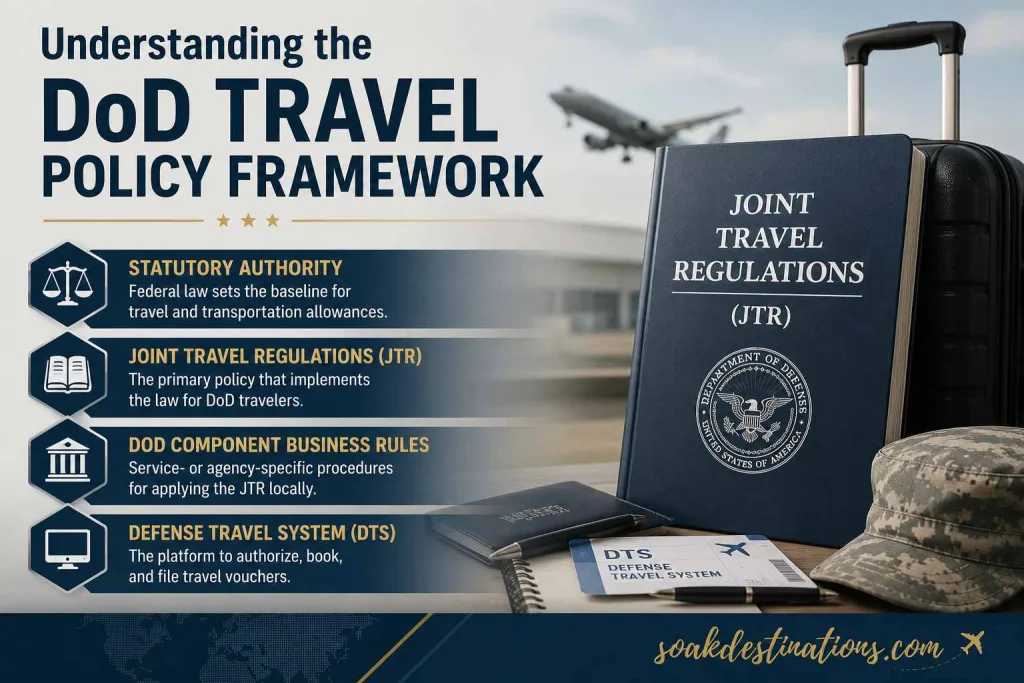
- Statutory authority – Federal law establishes the baseline for what travel and transportation allowances are legally permissible.
- The Joint Travel Regulations (JTR) – The primary policy document that implements that law for DoD travelers.
- DoD Component business rules – Service- or agency-specific procedures that clarify how the JTR is applied locally.
- The Defense Travel System (DTS) – The platform used to create authorizations, book travel, and file vouchers.
Why This Layered Structure Matters
Because the JTR sits above Component business rules in authority, no local policy, command guidance, or individual approving official can override, contradict, or expand what the JTR permits. This is the foundation for understanding what is not true about DoD travel policy — most myths involve someone believing a lower-level rule can trump the JTR.
What is Not True About DoD Travel Policy? The Core Misconception
If you’ve taken DTS training or seen this question on a quiz, the answer format is usually multiple choice, asking you to identify the false statement among several true ones. The statement that is not true is almost always some version of:
“An AO can approve payment for expenses or items not specifically addressed by the JTR.”
This is false because:
- The JTR is the controlling authority for DoD travel and transportation allowances.
- Items not addressed by the JTR are not automatically reimbursable — silence in the regulation is not permission.
- Approving an unaddressed expense would constitute an illegal or improper payment, exposing both the traveler and the AO to personal liability.
- When the General Services Administration’s Federal Travel Regulation (FTR) allows a discretionary allowance the JTR doesn’t address, that allowance still isn’t authorized for DoD travelers unless the JTR separately adopts it.
This is the single most tested and most misunderstood point in DoD travel training, which is why “what is not true about DoD travel policy” continues to be one of the most searched phrases among DTS learners.
The Real Authority of an Authorizing or Approving Official (AO)
A lot of confusion around DoD travel stems from misunderstanding what an AO can and cannot do. Contrary to popular assumption, an AO’s authority is not open-ended.
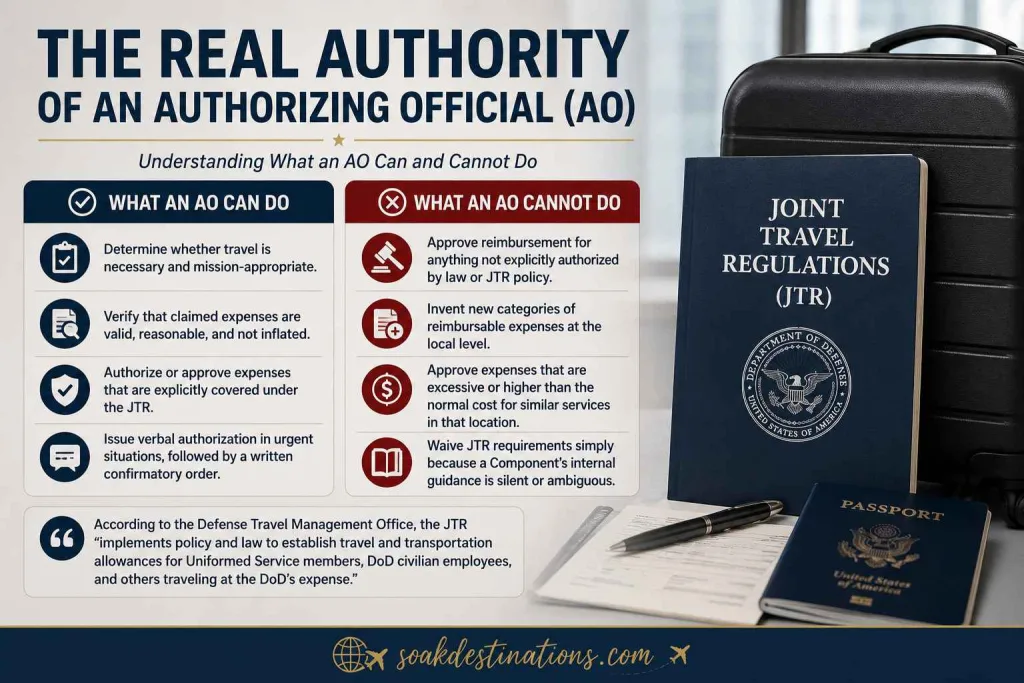
What an AO Can Do
- Determine whether travel is necessary and mission-appropriate.
- Verify that claimed expenses are valid, reasonable, and not inflated.
- Authorize or approve expenses that are explicitly covered under the JTR.
- Issue verbal authorization in urgent situations, followed by a written confirmatory order.
What an AO Cannot Do
- Approve reimbursement for anything not explicitly authorized by law or JTR policy.
- Invent new categories of reimbursable expenses at the local level.
- Approve expenses that are excessive or higher than the normal cost for similar services in that location.
- Waive JTR requirements simply because a Component’s internal guidance is silent or ambiguous.
According to the Defense Travel Management Office, the JTR “implements policy and law to establish travel and transportation allowances for Uniformed Service members, DoD civilian employees, and others traveling at the DoD’s expense” — language that leaves little room for discretionary interpretation outside the regulation itself.
What the JTR Actually Covers
Another area where people get tripped up is assuming the JTR only covers certain travel types. In reality, the JTR is comprehensive.

- TDY travel allowances – Per diem, lodging, meals, and incidental expense rates for Temporary Duty travel.
- Transportation – Authorized modes of travel, mileage reimbursement, and rest-stop rules for long-haul flights.
- Reimbursable expenses – Costs directly tied to the mission, properly documented and within JTR limits.
- Permanent Change of Station (PCS) – Allowances tied to relocating a service member’s or civilian’s official duty station.
Both TDY allowances and reimbursable expenses fall under the same JTR umbrella — they are not governed by separate, disconnected rulebooks, which is another common point of confusion.
Component Business Rules: What They Can and Cannot Do
DoD Components (Army, Navy, Air Force, and others) are permitted to issue their own business rules and administrative procedures. But there’s a hard limit on what those rules can do.
- Component rules can clarify procedures, set internal approval workflows, or provide additional guidance for ambiguous situations.
- Component rules cannot conflict with the JTR.
- Component rules cannot unnecessarily duplicate JTR provisions in a way that creates confusion.
- Component rules cannot create new reimbursable expense categories that the JTR does not recognize.
This is precisely why the Per Diem, Travel, and Transportation Allowance Committee (PDTATAC) reviews Component-level material — to make sure per diem, travel, and relocation allowances are applied uniformly across the entire Department of Defense.
Why Getting This Right Matters for Every Traveler
Understanding what is not true about DoD travel policy isn’t just a trivia exercise for a DTS quiz — it has real financial and legal consequences.
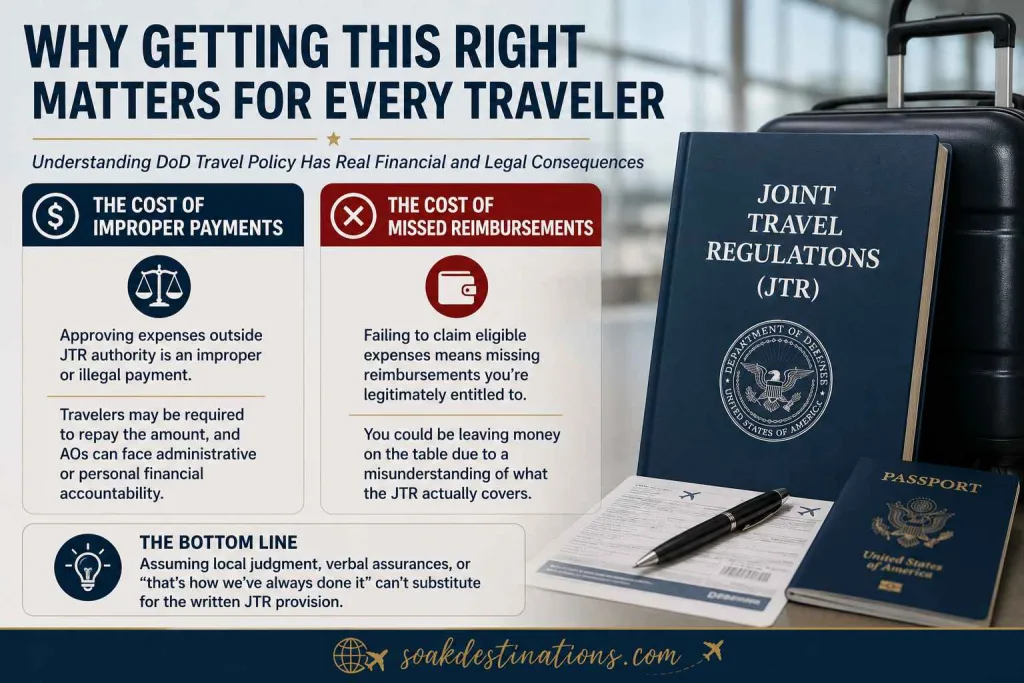
The Cost of Improper Payments
When an AO approves an expense outside JTR authority, it’s classified as an improper or illegal payment. Travelers may be required to repay the amount, and AOs can face administrative or even personal financial accountability for the error.
The Cost of Missed Reimbursements
On the flip side, travelers who don’t understand what the JTR actually covers sometimes fail to claim expenses they’re legitimately entitled to — leaving money on the table simply due to a misunderstanding of the regulation’s scope.
Both outcomes trace back to the same root issue: assuming local judgment, verbal assurances, or “that’s how we’ve always done it” can substitute for the written JTR provision.
Common DoD Travel Policy Myths Beyond the AO Question
While the AO/JTR relationship is the headline issue, a few related myths tend to circulate alongside it:
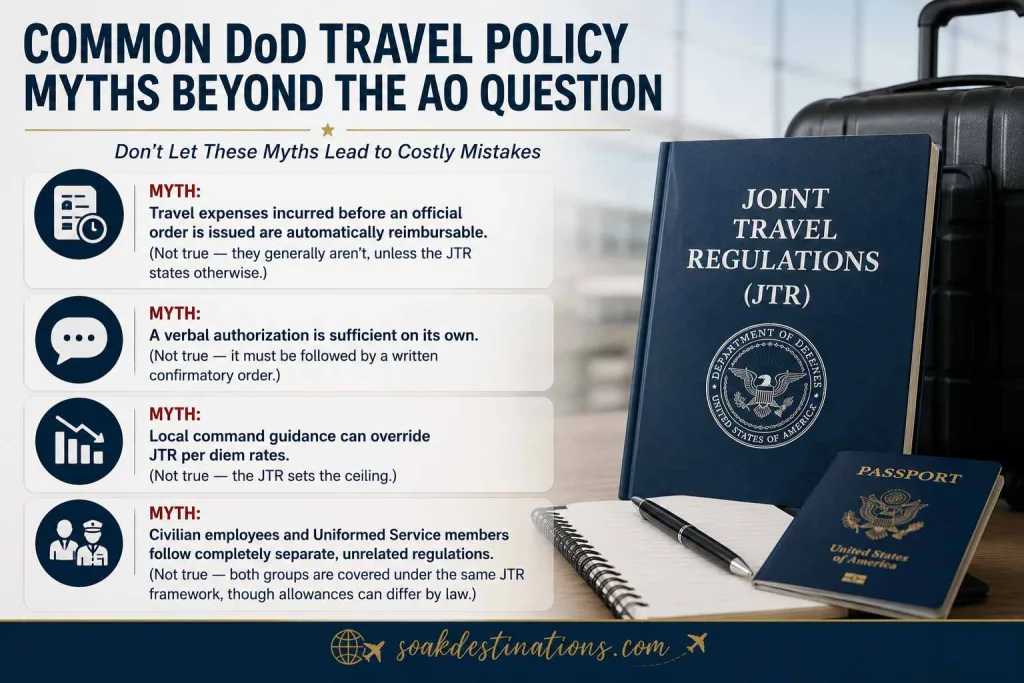
- Myth: Travel expenses incurred before an official order is issued are automatically reimbursable. (Not true — they generally aren’t, unless the JTR states otherwise.)
- Myth: A verbal authorization is sufficient on its own. (Not true — it must be followed by a written confirmatory order.)
- Myth: Local command guidance can override JTR per diem rates. (Not true — the JTR sets the ceiling.)
- Myth: Civilian employees and Uniformed Service members follow completely separate, unrelated regulations. (Not true — both groups are covered under the same JTR framework, though allowances can differ by law.)
If you’re studying for DTS certification or simply trying to file an accurate voucher, keeping these distinctions straight is the difference between a smooth approval and a rejected claim.
Planning Recovery Time After Official Travel
TDY and PCS travel can be physically and mentally draining — long flights, tight schedules, and unfamiliar time zones take a toll even when every voucher is filed correctly. Many service members and DoD civilians use authorized leave time after extended travel to reset before returning to full duty.
If your next stop after a demanding TDY assignment includes some downtime, exploring destinations known for natural hot springs can be a genuinely restorative way to unwind. Resources like Soak Destinations make it easy to find relaxing hot spring locations near your travel route, whether you’re decompressing after a long deployment cycle or simply building in a wellness stop during official leave.
Key Takeaways
- What is not true about DoD travel policy? That an AO can approve expenses not specifically addressed by the JTR — this is the core misconception.
- The JTR is the controlling authority for all DoD travel and transportation allowances, covering both TDY allowances and reimbursable expenses.
- AOs must operate strictly within JTR limits; they cannot invent new reimbursement categories.
- Component business rules can clarify JTR provisions but never contradict or expand them.
- Understanding what is not true about DoD travel policy protects both travelers and AOs from improper payment liability.
Final Thoughts
DoD travel policy is built on a clear hierarchy: law, then the JTR, then Component-level clarification — never the reverse. Whenever someone asks, “what is not true about DoD travel policy,” the answer almost always circles back to the same point: no official, no matter how well-intentioned, can approve what the JTR does not authorize. Keeping that principle in mind is the single best way to file accurate travel claims, avoid improper payments, and understand your actual entitlements as a DoD traveler.