
Can Americans Travel to Cuba? The Complete 2026 Legal Travel Guide

Cuba sits just 90 miles off the coast of Florida, yet for decades it has felt like one of the most complicated destinations for U.S. citizens to reach legally. Between embargoes, sanctions, and shifting political administrations, the rules have changed more than once — and they keep changing. So, can Americans travel to Cuba in 2026?
The short answer is yes, but not as a typical tourist. This guide breaks down exactly what U.S. law allows, what documents you need, and how to plan a trip that keeps you fully compliant while still experiencing everything Cuba has to offer.
Can Americans Visit Cuba in 2026? What the Law Actually Says
Yes — can Americans travel to Cuba is one of the most searched travel questions for a reason, and the answer is more nuanced than a simple yes or no. U.S. citizens are permitted to visit Cuba, but pure vacation or recreational tourism remains prohibited under federal law. Instead, every American traveler must qualify under one of the categories authorized by the U.S. Department of the Treasury’s Office of Foreign Assets Control (OFAC).
This isn’t a loophole or a technicality you can ignore. It’s a legal requirement, and travelers are expected to self-certify their qualifying category and keep supporting records. The good news: most trips built around culture, food, music, and genuine interaction with Cuban communities easily satisfy these requirements without feeling restrictive at all.
Understanding U.S. Travel Restrictions to Cuba
The Cuban embargo dates back to the 1960s, and travel-related transactions are still governed by the Cuban Assets Control Regulations (CACR) under 31 CFR Part 515. According to the U.S. Embassy in Havana, individuals who meet the conditions of an authorized general license do not need to apply separately to OFAC before traveling.
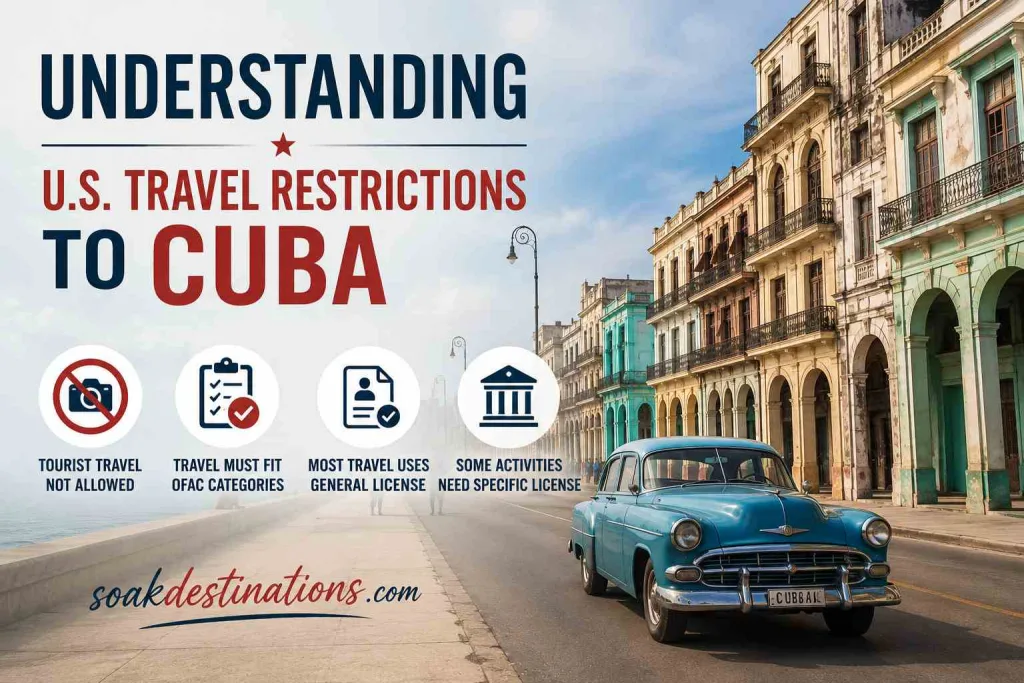
In practice, this means:
- Tourist or recreational travel is not allowed under any circumstance.
- Travel must fall into one of the OFAC-approved categories.
- Most travelers use a “general license,” which requires self-certification rather than prior government approval.
- A small number of activities require a “specific license,” which involves a formal OFAC application.
So when people ask, “can Americans travel to Cuba legally,” the real question is which authorized category their trip falls under — not whether travel is possible at all.
The 12 Authorized Travel Categories
OFAC recognizes 12 categories of authorized travel to Cuba. To stay compliant, your trip’s primary purpose should align with one of these:
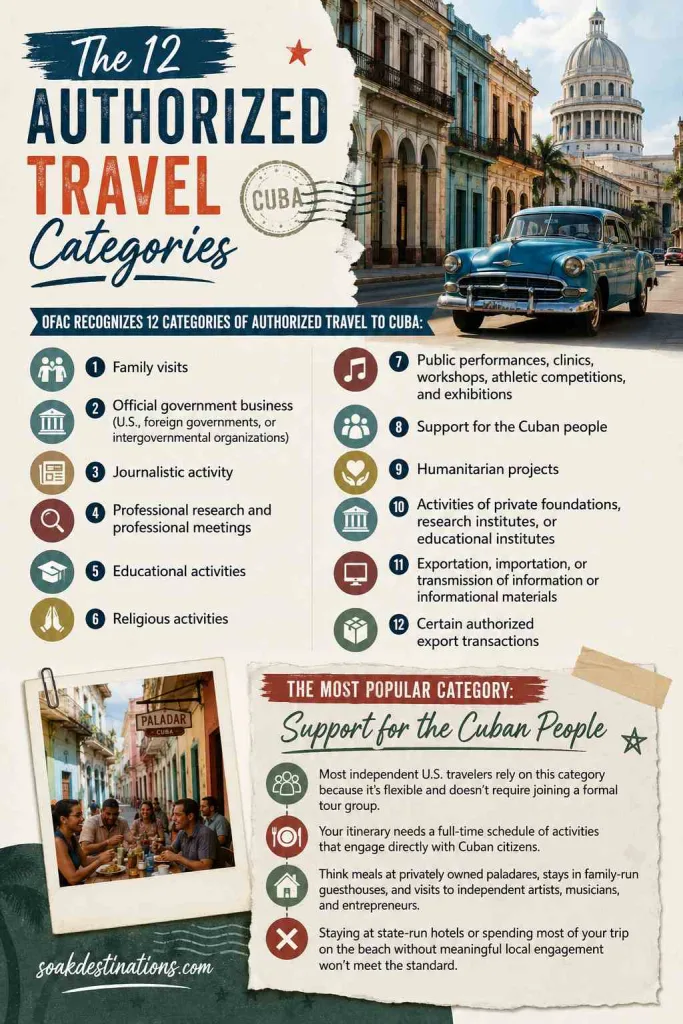
- Family visits
- Official government business (U.S., foreign governments, or intergovernmental organizations)
- Journalistic activity
- Professional research and professional meetings
- Educational activities
- Religious activities
- Public performances, clinics, workshops, athletic competitions, and exhibitions
- Support for the Cuban people
- Humanitarian projects
- Activities of private foundations, research institutes, or educational institutes
- Exportation, importation, or transmission of information or informational materials
- Certain authorized export transactions
The Most Popular Category: Support for the Cuban People
Most independent U.S. travelers rely on the “Support for the Cuban People” category because it’s flexible and doesn’t require joining a formal tour group. To qualify, your itinerary needs a full-time schedule of activities that engage directly with Cuban citizens — think meals at privately owned paladares, stays in family-run guesthouses, and visits to independent artists, musicians, and entrepreneurs. Staying at state-run hotels or spending most of your trip on the beach without meaningful local engagement won’t meet the standard.
Entry Requirements for U.S. Travelers
Beyond satisfying an OFAC category, there are a handful of practical entry requirements every American needs to handle before departure.
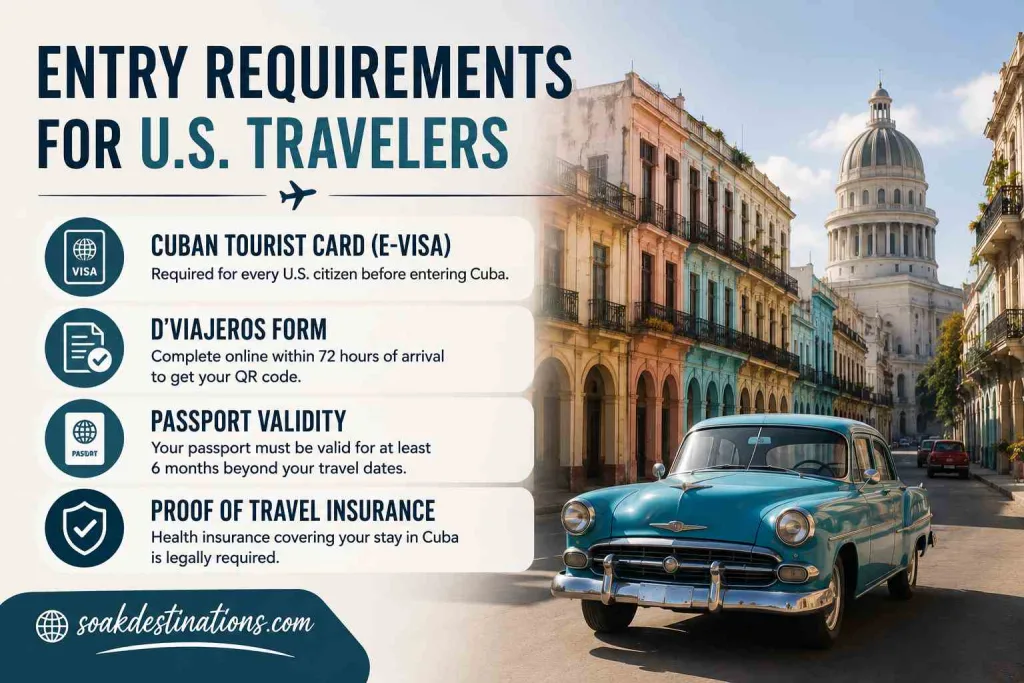
- Cuban Tourist Card (E-Visa): Every U.S. citizen must obtain a Cuban visa, often called a tourist or visitor card, before entering the country. Major U.S. carriers such as American, Delta, and United typically sell these directly or provide clear instructions for obtaining one.
- D’Viajeros Form: Cuba requires all incoming travelers to complete an online D’Viajeros customs and health declaration within 72 hours of arrival, which generates a mandatory QR code for entry.
- Passport Validity: Your U.S. passport should have at least six months of validity remaining beyond your travel dates.
- Proof of Travel Insurance: Health insurance covering your stay in Cuba is legally required. Most commercial flights departing the U.S. already bundle this into the ticket price.
For the most current entry rules, the U.S. Department of State’s Cuba travel page is the authoritative source, and it’s worth checking shortly before you book, since conditions can shift with little notice.
Financial and Currency Rules You Can’t Ignore
This is where many first-time visitors get caught off guard. Because of the ongoing sanctions, U.S. debit and credit cards do not work anywhere in Cuba.

- Bring enough U.S. cash to cover your entire trip, plus an additional 20–30% buffer for emergencies or unexpected costs.
- U.S. dollars can be exchanged for Cuban pesos at the airport, hotels, or official exchange houses (CADECAs), though rates vary.
- ATMs tied to U.S. banking networks are not accessible, so plan your cash needs carefully before departure.
- Keep smaller denominations on hand, since making change for larger bills can be difficult outside major tourist areas.
Where You Can (and Can’t) Stay
Accommodation choices matter just as much as your activities when it comes to compliance.
- Hotels and restaurants owned or operated by the Cuban military or government are off-limits to U.S. travelers under the Cuba Restricted List.
- Privately owned guesthouses, known as casas particulares, are the go-to option for most Americans, along with vetted Airbnb listings.
- Staying with a local family isn’t just a compliance checkbox — it’s often the most memorable part of the trip, offering home-cooked meals and genuine cultural exchange you won’t find in a resort.
Cuba’s appeal goes well beyond Havana’s colorful streets and classic cars. Travelers drawn to nature-based itineraries often build time into their schedule for the island’s mineral-rich hot springs, tucked into regions like Ciénaga de Zapata and the Escambray Mountains, which pair naturally with wellness-focused travel. If soaking in geothermal waters around the world is part of your travel bucket list, resources like Soak Destinations are a great place to research hot spring destinations before you map out your next international itinerary, whether that’s Cuba or beyond.
Record-Keeping: The Requirement Most Travelers Forget
Because most Americans travel under a general license rather than a pre-approved specific license, the burden of proof falls on you. U.S. regulations require travelers to retain records of their trip for five years, including:

- A day-by-day itinerary of activities
- Receipts from accommodations, meals, and transportation
- Documentation showing engagement with the qualifying OFAC category
These records are rarely checked, but if they are requested, having organized documentation is the difference between a minor inconvenience and a serious compliance issue.
Getting to Cuba From the United States
Direct commercial flights operate from several major U.S. hub airports, including Miami (MIA), Houston (IAH), and New York (JFK), to Havana and other Cuban cities. If you’re departing from Miami specifically, budget extra time at the airport for the dedicated “Cuba Ready” check-in process, which includes additional documentation checks specific to Cuba-bound passengers.

Booking Tips for a Smoother Trip
- Confirm with your airline whether the Cuban tourist card is included or must be purchased separately.
- Double-check that your travel insurance policy explicitly covers Cuba, since some standard policies exclude sanctioned destinations.
- Build a realistic itinerary before you fly — it will make completing the D’Viajeros form and your OFAC category self-certification far easier.
Final Thoughts
So, can Americans travel to Cuba in 2026? Absolutely — as long as the trip is structured around one of the government’s approved categories, documented properly, and planned with Cuba’s cash-based economy in mind. For travelers willing to embrace a more immersive, people-first style of travel, Cuba offers an experience that’s hard to replicate anywhere else in the Caribbean: vibrant music, colonial architecture, warm hospitality, and a culture that rewards genuine curiosity. With the right preparation, a legal and unforgettable Cuban adventure is well within reach.
Frequently Asked Questions
Can Americans travel to Cuba for tourism only?
No. Pure tourism is not an authorized category. Every trip must fall under one of the 12 OFAC-approved purposes, even if your days include plenty of sightseeing alongside qualifying activities.
Can Americans fly to Cuba directly from the U.S.?
Yes, direct commercial flights are available from cities including Miami, Houston, and New York, operated by major U.S. carriers.
Do dual citizens face different rules?
U.S.-Cuban dual citizens generally travel under a separate, more flexible framework related to family visits, though it’s worth confirming specifics with the Cuban Embassy in Washington, D.C., before departure.
Is a specific OFAC license required for most travelers?
No. Most Americans qualify under a general license, particularly the “Support for the Cuban People” category, and simply self-certify rather than applying for individual approval.