
Most Dangerous States in USA (2026): Top 12 States Ranked by Crime Data

This guide ranks the Most Dangerous States in USA for 2026, based on the latest FBI Uniform Crime Reporting (UCR) data, cross-referenced with USAFacts’ analysis of federal crime trends. Rather than repeating headlines, this breakdown looks at what the actual violent and property crime numbers show — state by state, region by region, and over time.
Key Takeaways
- Alaska posts the highest violent crime rate in the country at 724.1 incidents per 100,000 residents, driven by geographic isolation and limited law enforcement coverage.
- New Mexico leads the nation in property crime at 2,751.1 incidents per 100,000 residents, while ranking second for violent crime.
- Louisiana holds the highest homicide rate of any state, concentrated heavily around New Orleans and Baton Rouge.
- Nationally, both violent and property crime hit their lowest levels since 1976 in 2024 — but state-level gaps remain wide.
- Northeastern states report violent crime rates roughly 22% below the national average, while Western states run about 21% above it.
- Crime is deeply regional even within a single state — a state’s average doesn’t reflect what any one city or county actually experiences.
How We Ranked These States
Rankings are built on two primary crime metrics drawn from the FBI’s Crime Data Explorer, the bureau’s official public database for UCR statistics:

- Violent crime rate (per 100,000 residents) — covers murder and nonnegligent manslaughter, rape, robbery, and aggravated assault
- Property crime rate (per 100,000 residents) — covers burglary, larceny-theft, and motor vehicle theft
Additional context factors include poverty rates, law enforcement staffing, population density, and geographic isolation, since these consistently correlate with elevated crime in the data.
Top 12 Most Dangerous States in USA (2026)

1. Alaska — Highest Violent Crime Rate in the Nation
Alaska’s violent crime rate of 724.1 per 100,000 residents is the highest in the country, and it isn’t close. Aggravated assault accounts for roughly 72% of violent crime here, with domestic violence and alcohol-related incidents a persistent concern. Vast rural distances mean emergency response can take hours rather than minutes in many communities.
| Crime Type | Rate per 100,000 |
| Violent Crime | 724.1 |
| Aggravated Assault | ~72% of violent crime |
2. New Mexico — Highest Property Crime Rate in the Country
New Mexico ranks second for violent crime at 717.1 per 100,000 residents, but it’s property crime where the state truly leads the nation — 2,751.1 incidents per 100,000 residents. High poverty (18.8%, compared to the 11.5% national average) and rural law enforcement gaps drive both figures.
| Crime Type | Rate per 100,000 |
| Violent Crime | 717.1 |
| Property Crime | 2,751.1 |

3. Tennessee — Memphis Drives a Statewide Problem
Tennessee’s violent crime rate sits at 592.3 per 100,000 residents, with Memphis functioning as the state’s primary hotspot for gang and drug-related offenses. Outside major metro areas, the state’s numbers drop considerably, making this a heavily concentrated urban issue rather than a uniform statewide risk.
4. Arkansas — Poverty and Rural Policing Gaps
Arkansas posts a violent crime rate of 579.4 per 100,000 residents. Cities like Little Rock and Pine Bluff see the bulk of aggravated assaults and robberies, while limited law enforcement resources in rural counties compound the statewide average.

5. Louisiana — Highest Homicide Rate in the Country
Louisiana’s violent crime rate of 519.8 per 100,000 residents comes with a distinction no state wants: the highest homicide rate nationally. New Orleans and Baton Rouge account for a disproportionate share, tied to drug trafficking and gang-related violence.
| Crime Type | Rate per 100,000 |
| Violent Crime | 519.8 |
| Property Crime | 2,296.4 |
6. Colorado — Property Crime Outpaces Violent Crime
Colorado’s violent crime rate runs lower than the states above it, but its property crime rate of 2,592.8 per 100,000 residents ranks among the five highest in the country. Vehicle theft and burglary, particularly around Denver, are the primary drivers.
7. California — Scale Amplifies the Numbers
California doesn’t top per-capita violent crime lists, but its enormous population means raw crime volume is significant. Property crime remains a persistent statewide issue, and the state consistently draws national attention despite its homicide rate hitting a near 60-year low in recent reporting.

8. Missouri — St. Louis Skews the Statewide Average
Missouri carries one of the highest homicide rates in the country, heavily concentrated around St. Louis. Economic inequality and concentrated poverty in specific neighborhoods are the primary factors cited by researchers studying the state’s crime patterns.
9. South Carolina — Rural Infrastructure Gaps
South Carolina’s elevated crime rate is closely tied to poverty and underfunded rural infrastructure. Unlike states where crime concentrates in one or two cities, South Carolina’s risk is more evenly spread across smaller communities statewide.
10. Nevada — Tourism and Transient Populations
Nevada’s crime profile is shaped heavily by Las Vegas’s high-traffic tourism economy and transient population. Visitors and short-term residents contribute to both violent and property crime statistics in ways that differ from most other states on this list.
11. Maryland — Baltimore Does Most of the Explaining
Maryland’s statewide numbers are driven almost entirely by Baltimore. Step outside the city into the DC suburbs or the Eastern Shore, and the picture brightens considerably — a clear example of how concentrated, rather than spread out, a state’s crime risk can be.

12. Oklahoma — Consistent Presence on National Lists
Oklahoma rounds out this list with elevated violent crime tied to poverty and substance abuse trends similar to its neighbors, Arkansas and Louisiana. It consistently appears across multiple independent crime-ranking methodologies, reinforcing its place among the Most Dangerous States in USA.
2026 Crime Statistics: Full Rankings Table
| Rank | State | Violent Crime Rate (per 100k) | Property Crime Rate (per 100k) | Primary Concerns |
| 1 | Alaska | 724.1 | Moderate | Domestic violence, isolation |
| 2 | New Mexico | 717.1 | 2,751.1 | Poverty, drug activity |
| 3 | Tennessee | 592.3 | Elevated | Memphis gang/drug crime |
| 4 | Arkansas | 579.4 | Elevated | Rural policing gaps |
| 5 | Louisiana | 519.8 | 2,296.4 | Highest homicide rate |
| 6 | Colorado | Moderate | 2,592.8 | Vehicle theft, burglary |
| 7 | California | Moderate | High (volume) | Scale, property crime |
| 8 | Missouri | Elevated | Moderate | St. Louis homicide rate |
| 9 | South Carolina | Elevated | Moderate | Rural infrastructure |
| 10 | Nevada | Moderate | Elevated | Tourism, transient crime |
| 11 | Maryland | Elevated | Moderate | Baltimore concentration |
| 12 | Oklahoma | Elevated | Elevated | Poverty, substance abuse |
Rates sourced from FBI Uniform Crime Reporting data and USAFacts’ 2024 crime analysis. States without a precise figure show relative severity based on multi-source crime rankings rather than a single confirmed FBI rate.
Key Factors Driving Crime in These States
The same handful of factors show up across nearly every state on this list:
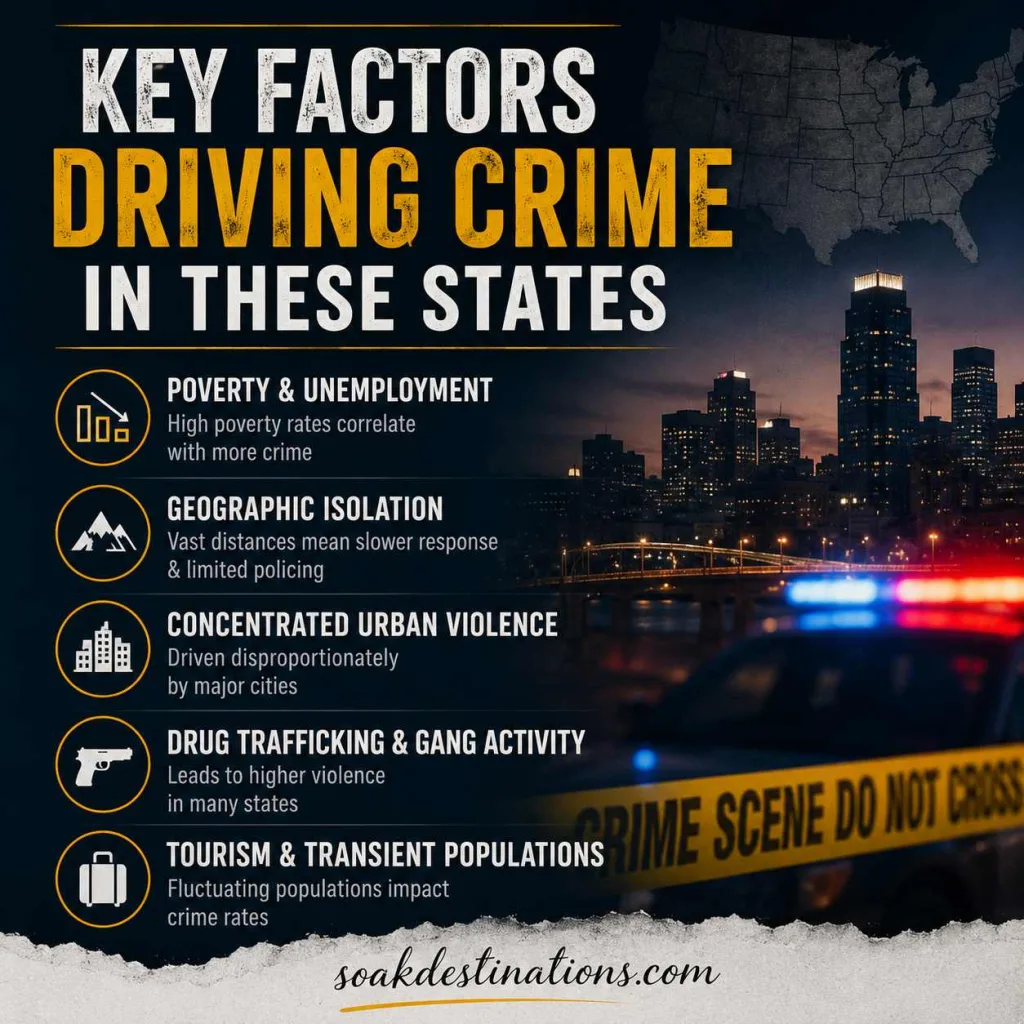
- Poverty and unemployment — states like New Mexico and Arkansas post poverty rates well above the national average, which correlates strongly with both violent and property crime
- Geographic isolation — Alaska’s vast rural distances mean slower emergency response and less consistent policing coverage
- Concentrated urban violence — Tennessee, Missouri, and Maryland’s statewide numbers are driven disproportionately by a single major city
- Drug trafficking and gang activity — a leading driver of homicide and aggravated assault in Louisiana, Oklahoma, and Arkansas
- Tourism and transient populations — Nevada’s numbers reflect a population that fluctuates daily in ways permanent-resident states don’t experience
National Crime Trends: What the Data Shows
The bigger picture is more encouraging than any single state ranking suggests:
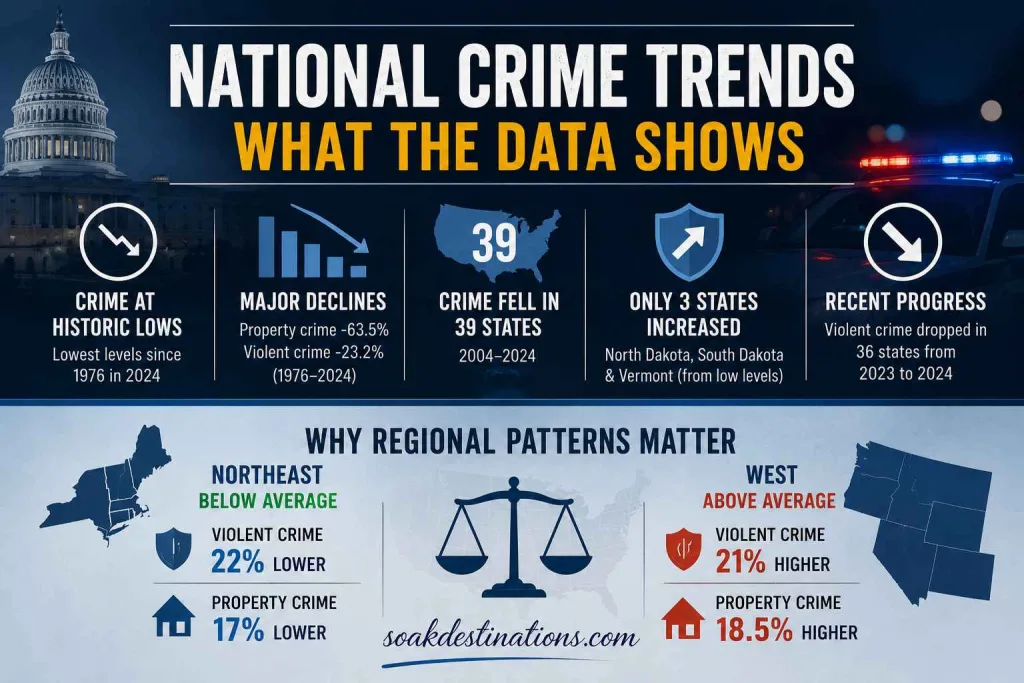
- Both violent and property crime hit their lowest points since 1976 in 2024, the earliest year with available federal data
- Property crime fell 63.5% between 1976 and 2024, while violent crime dropped 23.2% over the same period
- Violent crime fell in 39 states between 2004 and 2024, with Florida, Connecticut, and Illinois posting declines over 45%
- Only North Dakota, South Dakota, and Vermont saw violent crime rise since 2004, though from very low starting points
- Between 2023 and 2024 alone, violent crime dropped in 36 states nationwide
Why Regional Patterns Matter
Northeastern states report violent crime rates roughly 22% below the national average and property crime about 17% lower, while Western states run about 21% above average for violent crime and 18.5% higher for property crime — a gap that has held steady for years.
Safest States: A Direct Contrast
Not every state fits the pattern above. Several consistently rank among the safest in the country:
- Maine — lowest violent crime rate nationally at 100.1 per 100,000 residents
- New Hampshire — 110.1 per 100,000 residents, and a strong performer across nearly every safety index
- Connecticut — 136.0 per 100,000 residents
- Rhode Island — 153.6 per 100,000 residents
- Idaho — lowest property crime rate nationally at 736.3 per 100,000 residents
- Vermont — consistently ranks in the top tier for overall composite safety scores
These states share higher median incomes, lower poverty rates, and denser law enforcement coverage relative to population — the inverse of what drives states higher on the dangerous list.
Practical Safety Tips for Travelers and Residents
A few habits make a meaningful difference whether you’re relocating to or simply passing through a higher-crime state:

- Research specific cities and neighborhoods rather than relying on statewide averages — risk within a single state can vary by several hundred percent
- Keep valuables out of sight in vehicles, especially in states with high property crime rates like New Mexico and Colorado
- Avoid isolated rural stretches after dark in states like Alaska and Arkansas, where emergency response times run longer
- Natural, low-density destinations tend to carry lower crime exposure than major metro cores — well-managed hot springs and outdoor getaways are a good example, and resources like Soak Destinations can help travelers find calmer, nature-focused options even within states that post higher urban crime numbers
- For relocation decisions, check city and county-level crime data directly rather than relying on a state’s overall ranking
Final Thoughts
The Most Dangerous States in USA list looks fairly consistent year over year — Alaska, New Mexico, Tennessee, Arkansas, and Louisiana anchor the top five almost every cycle. But the deeper story is regional: poverty, geographic isolation, and concentrated urban violence explain far more than any single statistic. Whether you’re using this data to plan a move or simply to stay informed, looking past the ranking number to what’s actually driving it gives a much clearer picture of real risk.