
Do Not Travel Warning 21 Countries: 2026 Full List & Guide

Planning an international trip in 2026 means checking more than flight prices and weather forecasts. It also means understanding where your government explicitly advises you not to go. The Do Not Travel Warning 21 Countries list, maintained by the U.S. Department of State, represents the highest tier of travel risk in the world — places where armed conflict, terrorism, kidnapping, or the near-total absence of consular support make travel genuinely dangerous.
This guide breaks down exactly which nations carry this designation, why they’re on it, what the warning actually means for U.S. citizens abroad, and how travelers can make smarter, safer decisions when choosing a destination.
What Is a “Do Not Travel” Advisory?
The State Department uses a four-tier color-coded system to rate risk in every country on earth. Each level reflects the department’s assessment of threats specifically as they relate to U.S. citizens, nationals, and legal residents — not a general judgment about a country as a whole.
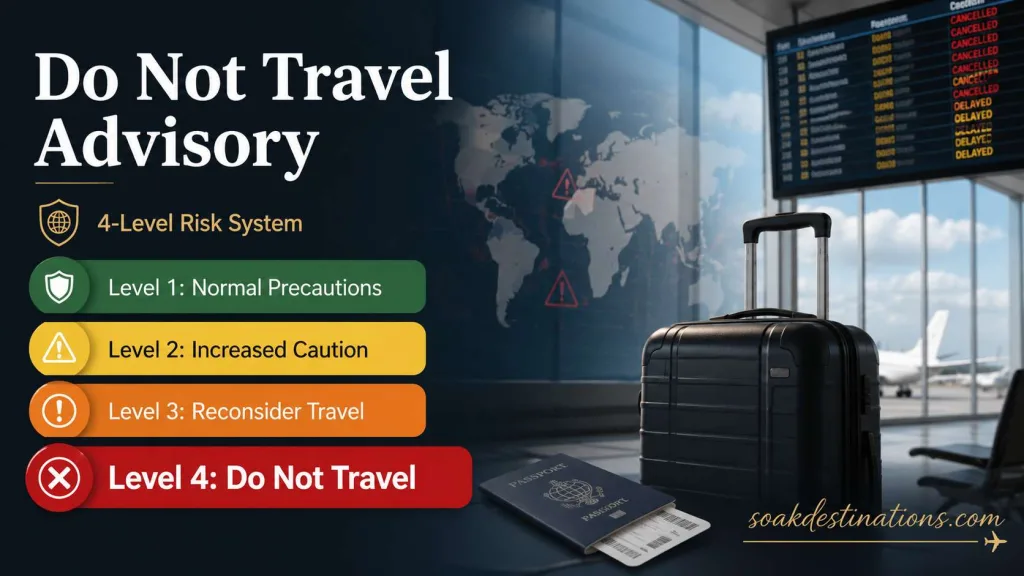
Level 1: Exercise Normal Precautions
This is the baseline level assigned to the large majority of countries. It doesn’t mean zero risk — no destination is risk-free — but it means no unusual dangers have been identified beyond ordinary travel awareness.
Level 2: Exercise Increased Caution
Countries at this level have some heightened risks, such as isolated crime or occasional civil unrest, but travel is still considered broadly acceptable with extra vigilance.
Level 3: Reconsider Travel
This level signals serious risks to safety and security. The State Department actively recommends travelers reconsider their plans, though it stops short of an outright warning against going.
Level 4: Do Not Travel
This is the highest and most severe advisory level. It’s reserved for destinations facing life-threatening conditions — active war, terrorism, widespread kidnapping risk, or a government with little to no ability to protect or assist American citizens in an emergency.
The Do Not Travel Warning 21 Countries List
As of 2026, the State Department has placed 21 countries under a Level 4: Do Not Travel advisory. (Note: some trackers list 22 destinations because the Israel–West Bank–Gaza advisory separately states “Do Not Travel to Gaza,” even though Gaza isn’t a standalone country entry.)
Every one of these advisories is published and continuously updated on the State Department’s official International Travel Advisories page, where travelers can look up real-time risk levels for any destination. Below is the full Do Not Travel Warning 21 Countries list with the specific, primary reason behind each designation.
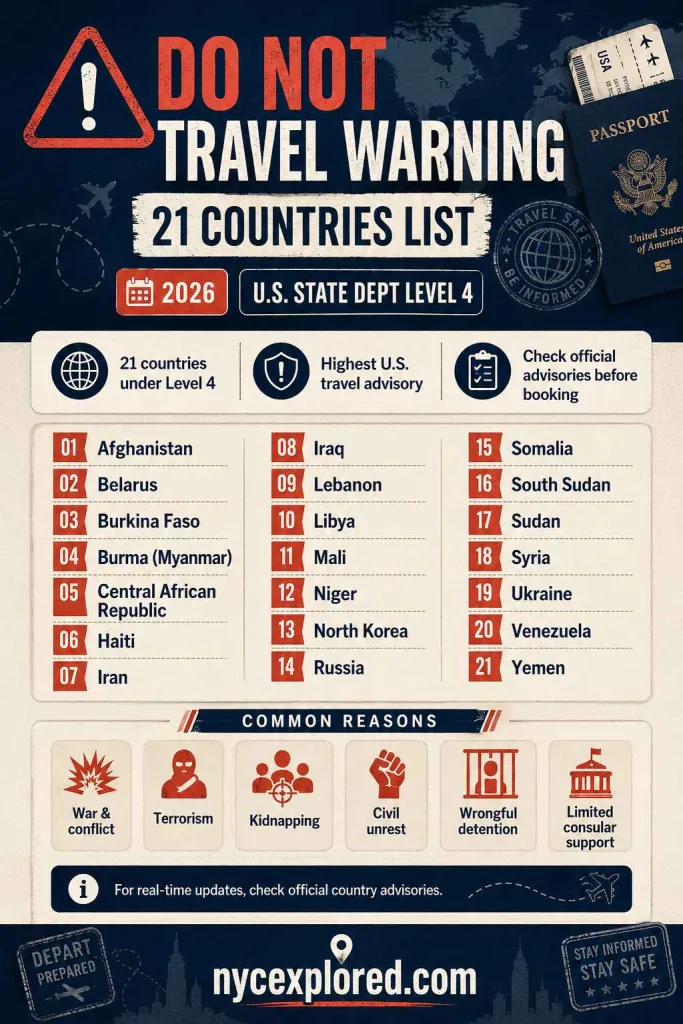
| Country | Primary Reason for Level 4 Advisory |
| Afghanistan | Terrorism, civil unrest, kidnapping risk, lack of U.S. embassy presence |
| Belarus | Detention risk for U.S. citizens, arbitrary law enforcement, support role in Russia’s war |
| Burkina Faso | Terrorism, coup-related instability, kidnapping |
| Burma (Myanmar) | Civil war, armed conflict, arbitrary arrest |
| Central African Republic | Armed conflict, crime, kidnapping, landmines |
| Haiti | Gang violence, kidnapping, civil unrest, weak law enforcement |
| Iran | Wrongful detention of U.S. citizens, terrorism |
| Iraq | Terrorism, armed conflict, kidnapping |
| Lebanon | Terrorism, cross-border armed conflict, civil unrest |
| Libya | Civil unrest, armed conflict, terrorism, no U.S. embassy support |
| Mali | Terrorism, kidnapping, armed conflict |
| Niger | Terrorism, kidnapping, civil unrest following coup activity |
| North Korea | Wrongful detention, arbitrary arrest, near-total lack of consular access |
| Russia | War-related instability, wrongful detention risk, limited consular support |
| Somalia | Terrorism, piracy, kidnapping, armed conflict |
| South Sudan | Armed conflict, crime, kidnapping |
| Sudan | Armed conflict, civil war, crime, evacuation of U.S. personnel |
| Syria | Terrorism, civil war, kidnapping, chemical weapon risk |
| Ukraine | Active war with Russia, missile strikes, landmines |
| Venezuela | Wrongful detention, crime, civil unrest, limited consular support |
| Yemen | Terrorism, civil war, landmines, kidnapping |
This table format is the fastest way to answer the two questions travelers usually have: which countries are on the list, and why. For deeper detail on any single destination — including sub-national regions with differing risk levels — the State Department’s country-specific advisory pages remain the most current source.
What “Do Not Travel” Actually Means in Practice
A Level 4 advisory is not a legal travel ban — with the sole exception of North Korea, which requires special passport validation under U.S. law for entry. For every other country on the list, Americans can technically still book a flight and go. What changes is the level of support waiting on the other side.
Consular Assistance Is Often Unavailable
In many Level 4 destinations, the U.S. embassy or consulate has reduced staff, suspended operations, or closed entirely, meaning there may be no one to call if a citizen is arrested, injured, or caught in a crisis.
Travel Insurance Frequently Won’t Cover You
Most standard travel insurance policies explicitly exclude coverage in Level 4 countries, leaving travelers responsible for costs like medical evacuation, which can run well into six figures out of pocket.
The State Department Recommends Extreme Preparation
For travelers who go anyway, the department’s guidance includes leaving a will, sharing a DNA sample with family, and identifying multiple exit routes in advance — a stark indicator of how seriously these warnings should be taken.
How the List Is Reviewed and Updated
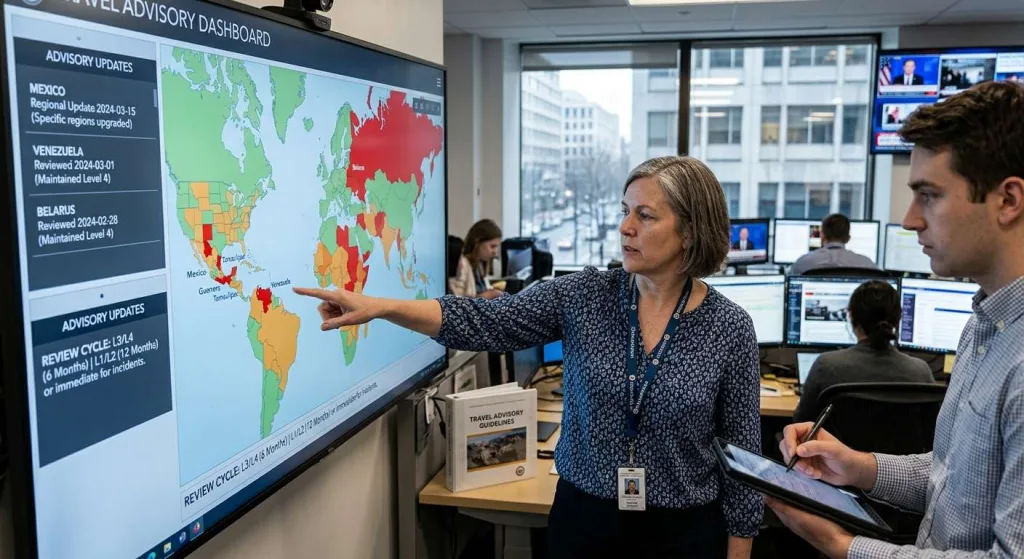
The Do Not Travel Warning 21 Countries list isn’t static. The State Department reassesses Level 3 and Level 4 advisories at least every six months, and Level 1 and 2 advisories roughly every 12 months — but any of them can change immediately if conditions shift, such as a coup, a new conflict, or a sudden security incident. Countries have moved on and off this list in recent years (Venezuela and Belarus, for example, were both added following escalating instability), which is why checking the current advisory before departure matters more than relying on last year’s headlines.
Some countries, like Mexico, don’t appear on the Level 4 list nationally but do have specific states or regions carrying a Level 3 or Level 4 designation — a reminder that risk can vary significantly within a single country, not just between them.
Staying Safer: Practical Steps for International Travelers
Whether you’re heading to a Level 2 country or simply want a safety net for any trip abroad, a few precautions go a long way:

- Enroll in the Smart Traveler Enrollment Program (STEP) to receive real-time security alerts and make it easier for the nearest U.S. embassy or consulate to reach you in an emergency.
- Check the advisory level for your exact destination, not just the country as a whole, since regional differences can be significant.
- Review health guidance alongside security guidance — for updated vaccine and outbreak information, the CDC’s Travel Health Notices are a useful companion resource to the State Department’s security-focused advisories.
- Purchase travel insurance that explicitly covers medical evacuation, and confirm in writing whether your destination is excluded.
- Share your itinerary with someone at home, including embassy contact information and a communication check-in schedule.
- Avoid predictable routines in higher-risk regions, and keep digital footprints and personal documents secure.
Choosing Calmer, Safer Destinations Instead
For travelers who’d rather trade high-risk itineraries for genuine rest and recovery, there’s an entire world of destinations that offer the opposite experience — slow, restorative, and low-stress. Thermal and mineral-rich hot springs destinations, for instance, are consistently rated among the safest and most relaxing types of travel, ideal for anyone looking to unwind rather than navigate conflict zones. If you’re weighing where to go next, resources like Soak Destinations curate some of the world’s best hot springs getaways, making it easy to plan a trip built around wellness instead of worry.
Swapping a Level 4 destination for a peaceful soak in a natural hot spring isn’t just safer — it’s often a far more rejuvenating way to spend a vacation, especially for travelers who want the physical and mental benefits of thermal water therapy without any of the security concerns tied to the countries on this list.
Final Thoughts
Understanding the Do Not Travel Warning 21 Countries list is essential for anyone planning international travel in 2026. These advisories exist because the State Department has identified genuine, often life-threatening risks — from active conflict to a near-total lack of emergency assistance — and they’re updated frequently enough that travelers should always verify the latest status directly at travel.state.gov before finalizing any trip.
For those looking for the opposite kind of experience, safer, slower-paced destinations centered around wellness and relaxation, like a well-planned hot springs retreat, remain some of the most rewarding — and worry-free — trips available today.